Showing posts with label Film. Show all posts
Sunday, April 29, 2012
Film in 2011: A Top 10
10. Heartbeats
Lifts technique effortlessly to create style. There is nothing original here, but the finished work is both immediate and compelling. Xavier Dolan is destined for great things.
9. Jane Eyre
A wonderfully atmospheric romance. The director moved from the gang wars of Mexico to classic British literature with almost too much ease.
8. A Dangerous Method
David Cronenberg continues to evolve as a filmmaker. Many say he's mellowed, but his films have simply become more internal, body horror replaced by mental chiller. This film alternates between being an unsettling account of a man's journey into his own mind and fascinating biopic. See it.
7. Certified Copy
A film that takes at least two viewings to piece it together, it is non stop thought provoking. Who are we watching? What is their relationship? Plus, Juliette Binoche gives her best performance in years.
Wednesday, January 25, 2012
Sleaze: A Case for the NC-17 Rating
Every year, it seems, a film is threatened with the dreaded NC-17 rating which restricts the audience of the film to adults only. Why is this rating considered the kiss of death for a film's earning potential? For years distributors have aimed for the magic PG-13 rating which seems to go hand in hand with wads of cash. This sort of thinking is exactly Hollywood's problem in so many areas, using shaky causation to maintain the status quo.
This sort of thinking can be seen with 3D where the conventional wisdom is that to compete with home theaters and pirated films, movies had to become a bigger spectacle. Along came Avatar and post-production 3D and soon it seemed that it was impossible to see a big budget film in 2D. It no longer became possible to discern what was causing the drop in ticket sales, and they certainly have continued to drop: 1.28 billion last year and a recorded drop in each of the last 7 years.
Monday, February 7, 2011
Top 15 Films of 2010
![]() |
| RED One Digital Camera; what many of this years most acclaimed films were shot on, including The Social Network |
In the 30's we reacted to the Great Depression with stories that all but ignored it. People wanted escapism on the sort of scale that they could only get at the movies. This time around (and maybe this says something about the scale of this crisis compared to that one) our greatest films tackle our problems head on. Small regional films like Winter's Bone, about a young girl who must do the unspeakable to protect her family, resonate far more than as isolated tales of woe and were more widely seen than they would have been even 5 years ago. Two other surprise box office successes in The Town and True Grit also tackled characters who were down and out, financially and otherwise. They are genre films tailored to our times, made with care and skill.
Labels:
David Fincher,
Edgar Wright,
Film,
List,
Sofia Coppola,
Year's Best
Sunday, January 30, 2011
Essential 5: Wong Kar-Wai
Wong Kar-Wai is often cited as the world's most romantic director. His films are known for characters who go through life as if there is nothing else but romance and they are shot so lovingly as to make even the most stone-hearted viewer agree. If that was all there was to him, he would still be a director worth watching -- genuine romance is almost impossible to find at the movies. His films are also filled with subtext. For instance, Wong always shows clocks and highlights the movement of time in every shot. On one level this merely hightens the sense that all relationships are finite, and so is heartbreak. On a second level though, he is referencing the ticking clock that Hong Kong (where many of his films take place) was under during British rule. Many of those who live in Hong Kong had fled mainland China after the rise of communism there and lived in Hong Kong to escape what they saw as an oppressive system. Wong Kar-Wai shows metaphorically the fear many in Hong Kong must have felt about the hand-over of power that happened in 1997.
Sunday, January 9, 2011
Evidence of Sanity
Assessing Art is difficult always, but it is particularly hard in the online film world right now. It is seemingly impossible to find your own voice and your own opinion. Everyone is writing about the same thing in the same way. Not to say it is entirely fruitless, right now is none-the-less one of the few times in the year when mainstream critics step back from individual films and look at the big picture. Yet, a consensus is easily formed (this year it's The Social Network) and even though that sort of thing is questioned, its always done in the same way.
Most critics are unwilling to adapt but one who is certainly not is Matt Zoller Seitz. He is one of the founders of the excellent and influential film blog The House Next Door and continues to write for Salon.com and the New York Times, among others. He is perhaps best known as one of the pioneers of new media in film criticism. What he has done with slide shows and short videos to both augment the usual review and create new ways of looking at films is refreshing. In this particular instance though, I was impressed by what he said in plain old print media about how two films changed his perceptions this year. The article stands head and shoulders above all criticism I've read in the past few months. And it can be read HERE.
Sunday, October 10, 2010
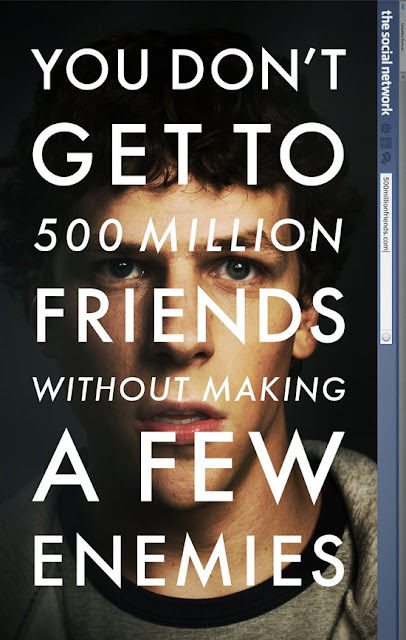
500 Million Friends (or The American Dream)
"Involuntarily I glanced seaward - and distinguished nothing except a single green light, minute and far way, that might have been the end of a dock. When I looked once more for Gatsby he had vanished, and I was alone again in the unquiet darkness." -F. Scott Fitgerald

The Social Network is easily the critical darling of the year. Everyone talks about the technical genius, the screwball paced dialogue, and the performances, but an examination of the film's relationship to the audience has been largely lacking. I believe that the film's true genius lies in the way it updates "The American Dream" to the modern era. Everyday we see self-made millionaires like Zuckerberg and celebrities with no more claim to fame than being friends with Paris Hilton (or being Paris Hilton for that matter) and we have almost no choice but to think about how it could be us -- suddenly rich for some simple idea or for who we know. That may be "The American Dream" but it isn't "The American Story". That story can be seen everywhere, from works of art like Citizen Kane to real life melodrama like William Randolph Hearst's censorship of that same film. The American Story is broken dreams and the corruption of ideals and no film has better shown it recently than The Social Network.
"I'll see you in my dreams" Essential 5: David Lynch
"My movies are film-paintings - moving portraits captured on celluloid. I'll layer that with sound to create a unique mood -- like if the Mona Lisa opened her mouth, and there would be a wind, and she'd turn back and smile. It would be strange and beautiful." - David Lynch
David Lynch is the rare artist capable of making the non-rational… digestible… maybe even understandable, and even if we can’t articulate that understanding, we can approximate it. Discussion inevitably turns to the darkness inside us all or the hidden face of seemingly idyllic communities. He often visualizes the fractured psyche, perhaps as a metaphor for society, or individuals, or even himself. Machines are a common motif, often juxtaposed with less ordered, organic imagery like physical deformities, fire, and waterfalls. All of this is true of Lynch, but beside the point. Few film authors are so visual, and none are quite so focused on evoking instead of explaining. Critics love to over-analyze Lynch, and I’m no exception.
For me at least, watching Lynch is like being under a spell. I’m mesmerized by the images, the story, and most of all by what it’s doing to me. Intellectual exercise is generally strenuous, and requires a great deal of conscious thought. With Lynch, though, you feel as if it is your subconscious getting the work-out. After I am done I feel as if I understand myself better or perhaps that I am more comfortable with myself in a way that is impossible to describe. Is intellectualism possible if it eludes your consciousness?
I’m going to resist the urge to delve deeper into the state Lynch puts me in. Nothing is more boring than someone else psychoanalyzing themselves. So, here are the essential films of David Lynch. His films taken together create a rich interconnected body of work that is best considered together. But you have to start somewhere and inevitably some make easier entrance points than others. If you are interested in this (very) important filmmaker I recommend starting here:
Monday, July 19, 2010
The Art of Criticism 6: Art and Objectivity
...All the same, if you say you dislike "The Godfather" or "Shawshank," I can't say you're wrong. The one thing you can never be wrong about is your own opinion. It's when you start giving your reasons that you lay yourself open. Many years ago there was a critic in Chicago who said "The Valachi Papers" was a better film than "The Godfather." "Phil," I told him, "film criticism is a matter of subjective opinion. Only rarely does it stray into objective fact. When you said 'The Valachi Papers' was better than 'The Godfather,' that was an error of objective fact." -Roger EbertAll the recent bellyaching about Inception has again led many to criticize those reviewers who gave the film a negative review. This, of course, has opened up a whole can of worms about the value of the film reviewer (often incorrectly equated with a critic), of having dissenting opinions, and what qualifies as a valid opinion. Roger Ebert gives a nice little defense of his profession (above). Yet, I can't help feeling as if he's dancing around the solutions. He's certainly right when he states, "film criticism is a matter of subjective opinion." The problem though is when he tries to bring objectivity into the equation. Briefly, objectivity is "mind-independent" or free from any judgments made by an entity. This excludes Science, Religion, Literature, Film, etc, etc. The only things it doesn't necessarily exclude are Mathematics and Philosophy, the only fields where actual "discoveries" are made (not "inventions"). Basically, I point this out in reference to Ebert's quote from above, "only rarely does it stray into objective fact." What exactly is an "objective fact" and how is it different from a fact (and what does this have to do with anything?)? I'll tell you:
Labels:
David Lynch,
Film,
Inception,
Roger Ebert,
The Art of Criticism
Sunday, July 18, 2010
"Man... is above all the plaything of his memory. "
Inception is easily the most divisive film of the year thus far (and lets face it, that's because its the only film released thus far that has both artistic intentions and box-office returns). I have a strong aversion to writing reviews, particularly in this sort of maelstrom, but I feel that I have to extract some thoughts (Harry Potter style!) and put them in my own personal pensieve. Before I get into the two specific things about the film I want to talk about, I suppose I should give my general thoughts on the film so you at least know where I'm coming from. Basically, I enjoyed it... which can be interpreted as I think it was cool, but not half as smart as it pretended to be.
Wednesday, June 9, 2010
The Glee Monster Revisisted
Glee is everywhere, its music is among the bestselling anywhere and the show's ratings have never been higher. While I have ranted against it previously (and plan to do some more of it in a bit), I do genuinely respect one aspect of it's conception, and that is the bravery and sheer balls it took to make it a musical. The strength of musicals has always been that they are able to simply and directly convey the inner thoughts of a character, that which is so easy to describe on page but so difficult on stage and on film. Musicals have long been an interest of mine; I count some of them as all-time favorites (Singin' in the Rain, Love Songs, and Top Hat), and a great many others as disappointments... should have beens.
Monday, May 24, 2010
The Art of Criticism 5: The Written Word vs. The Moving Image
I think it's very possible that this last decade will come to be viewed as one of the most important in the development of the branch of the arts that includes movies, television, and youtube videos among others. That isn't to say that youtube is the equivalent of the printing press or that "The Wire" is the equivalent of Hamlet but its pretty undeniable that a huge leap forward has been taken. While for centuries the written word has been widely respected for its artistic merit in all sorts of forms (from a novel to a short story, and prose to poetry), the movies have dominated all discussion of artistry in the moving images. It is quickly becoming undeniable that movies, television, and short form video all constitute one of the most important art forms today. Vadim Rizov, in his recent blog entry "Why we need better television criticism", argues that because television has been seen as film's unimportant cousin for so long there are hardly any reputable television critics (not to mention the time commitment to watch all the important shows of the past as well as the present). Yet, television is becoming increasingly important and Rizov is onto something with his call for better criticism in that field.
Tuesday, May 18, 2010
Godard on Trailers
Movie trailers, in today's internet centric movie climate, have almost replaced movies. Needless to say, this is a sorry state of affairs and I am a textbook example of the problem. Trailers can, at best, give you a sense of the plot, atmosphere, and visuals of a film. At worst they can make a good movie look bad and make a bad movie look good. Its certainly not the most reliable way to judge a movie's potential quality. More reliable measures include sticking with known artists (generally directors) of a certain level of skill and reading reviews. Sure, there's the easy argument that in a country where more than 650 movies are released each year, deciding what to see in your limited time is the most important and most difficult part of being serious about movies, and one of the best ways to decide is to watch trailers. The first part of that is pretty undeniable, not seeing everything you'd like to is par for the course. The second part, though, is a serious fallacy that seems solid when its floating around, unexamined, in the subconscious but has all sorts of problems when its really examined. Plus, watching trailers is, at first, quality control but quickly devolves into being a substitute for the movie (to be fair, this is sometimes warranted -- take the trailer for Letters to Juliet which IS the movie). So, it seems particularly fitting that the latest Jean-Luc Godard trailer IS his latest film, sped up to fit into about 4 minutes. The Coen brothers hinted at this sort of irreverence with the trailer to their last film, A Serious Man, but didn't quite reach the heights of this latest bit of genius from one of the great film artists:
Sunday, April 18, 2010
"POW!" "SWA-A-P" "KAPOW!" "SWOOSH!" "URRK!"
Perhaps the oldest debate in cinema, what is "appropriate" to show on screen, has recently flared up yet again. From the Hayes Code of 1934 to Bonnie and Clyde in 1967 to Kick-Ass there has always been some expression of how far the boundaries of realistic violence should be stretched. Never has the argument been resolved. Instead it always seems to get shelved until the next boundary pushing movie is released. This time it's a movie involving an 11-year old girl who brutally kills at least 30 people and then is beaten nearly to death (we have certainly come a long ways from this). I cannot relate to the controversies of old, as they seem painfully tame in comparison to what is shown today, but I can't help thinking that Kick-Ass is endemic of a change in the way that we view all visual media. The criticism of Kick-Ass is split almost by generation, with Roger Ebert and A.O. Scott, as usual, writing most eloquently against the film, and a mixed bag of younger bloggers writing for it.
Saturday, March 20, 2010
“Your future is all used up.” Essential 5: Film Noir
"I say a murder is abstract. You pull the trigger and after that you do not understand anything that happens." -Jean-Paul Sartre, 1948

Film noir is one of those things which will never be truly defined. Film scholars will be squabbling over it until there are no more film scholars. That doesn't mean that the question isn't important and doesn't shed light on the films themselves. I feel almost as if giving my two cents is a right of passage. After reading many who have attempted what I myself am attempting here, I think its possible to break down most thinkers into three distinct camps, those who try to define noir in terms of: pure aesthetics; character traits, setting, and plot elements (the things, or semantic elements); and the themes and context (the syntactic elements). It seems to me that none of these is exactly right in and of itself but rather the answer lies in some combination.

Film noir is one of those things which will never be truly defined. Film scholars will be squabbling over it until there are no more film scholars. That doesn't mean that the question isn't important and doesn't shed light on the films themselves. I feel almost as if giving my two cents is a right of passage. After reading many who have attempted what I myself am attempting here, I think its possible to break down most thinkers into three distinct camps, those who try to define noir in terms of: pure aesthetics; character traits, setting, and plot elements (the things, or semantic elements); and the themes and context (the syntactic elements). It seems to me that none of these is exactly right in and of itself but rather the answer lies in some combination.
Labels:
Billy Wilder,
Essential 5,
Film,
Film Noir,
List,
Nicholas Ray,
Orson Welles
Thursday, March 11, 2010
Essential 5: Pedro Almodóvar
Pedro Almodóvar is arguably the most important Spanish film director since Luis Buñuel. He is well known for his melodramatic plots, use of Hitchcockian suspense techniques, and gay themes. His films are most often compared to those of Douglas Sirk, the under-appreciated creator of many melodramas in the United States in the 1950s. Much like Sirk, his films are deceptively complex and are most notable for their use of eye-popping color. Also like Sirk, his films are often disregarded and misunderstood.
Tuesday, February 16, 2010
Princesses, Post-feminism, and Hollywood
A recent New York Times article about Nancy Meyers praised the director for rising to the top of the romantic comedy genre. Its an achievement to be sure, for any female director (in a Hollywood system in which women comprise 9% of all directors) to rise to the top of the heap. Yet the article has many up in arms. Some say that praising the director for her accomplishments loses sight of the struggle women are still going through in Hollywood, while still others take issue with calling her success an achievement at all.
Wednesday, February 10, 2010
Essential 5: Alfred Hitchcock
Alfred Hitchcock is, quite simply, my favorite director. Vertigo was a revelatory experience for me, and after seeing it I recognized movies for the first time as an art form. I began what has been a strange and wonderful journey into an unknown, beautiful world. Since that initial experience I've seen many worthwhile films, and all of them seen through the filter that is Hitchcock. It isn't that I don't think that other directors have matched any one of his films but no director can claim the sheer number of masterpieces that Hitchcock produced. The breadth and depth of his work is awe inspiring. So, in case my word orgasm didn't give it away, take this with a grain of salt, I am extremely biased and not going to pretend otherwise.
Tuesday, February 2, 2010
The 15 Best of 2009 (And Some Other Loose Ends)
The year in film can only be seen in relation to the global economic crisis that seems to define it. Much like the films of the early 30's this year was about escapism, yet it was escapism tempered by allegorical overtones. As if suggesting that instead of closing our eyes to whats going on around us we are merely squinting. A good friend of mine after enthusiastically gushing about Avatar suggested that he wished he could be an Avatar on some distant world. That might be a pitch perfect summation of the escapist feeling of the movie-going public in a year dominated by Transformers and Avatar. As A.O. Scott said "our movie avatars can travel freely through time and space, skipping over metaphysical borders with digitally enabled ease." Movie technology has never been better equipped to provide the mass therapy the world so desperately needs. Yet the question arises: did the movies succeed? The most successful films of the year were aimed at teenagers, those least in need of escapist fun in a world where joblessness is reaching ever greater heights. There has been a significant number of words devoted to the lack of adult films being given wide release and those accusations seem even more spot on when one looks at what some of the most popular "auteurist" releases this year (Wes Anderson's Fantastic Mr. Fox, Spike Jonze's Where the Wild Things Are, and James Cameron's Avatar). Yet it has been a good year for the movies, a sort of defiant hoorah in the face of an ever more depressing reality.
Friday, January 22, 2010
The Greatest Films of All Time: 2010 Update
If, based on the title, you are expecting to see my own list set out, then I'm afraid you'll be mistaken (but probably not disappointed). I wouldn't presume to, based on my limited and idiosyncratic viewing history, make that sort of attempt. Instead I want to highlight the newest update on what has become to many (myself included) the quintessential such list. They Shoot Pictures Don't They is basically an amalgamation of many reputable such lists into a surprisingly cohesive and satisfying whole. That isn't to say that criticism of the list isn't justified, as Kevin Lee points out the list is extremely biased towards films made in the US and Europe almost ignoring films from countries with rich cinematic history like India and China as well as the films of Africa and and the rest of Asia. The beauty of such a list, though, is giving burgeoning cinephiles and critics everywhere a place to start. I personally relied really heavily on the list when I was first starting out and cannot express how many great films I have seen as a result of their inclusion on the list. As much as many critics shrug at such things, the power of such a list to give people a place to start as well as a goal can't be easily dismissed.
Monday, January 18, 2010
The Infamous Video Review of Star Wars Episode I: The Phantom Menace
A 70 minute, 7-part review of Star Wars Episode I: The Phantom Menace (1999) has been making the rounds for a while now. I got it from /Film and The House Next Door but I've really seen it EVERYWHERE. Its completely worth it though, so brave its long running time for a hilarious and thoughtful review of the best example of "cinematic blueballs" in the history of film.
Subscribe to:
Posts (Atom)