Wednesday, January 25, 2012

Sleaze: A Case for the NC-17 Rating


Every year, it seems, a film is threatened with the dreaded NC-17 rating which restricts the audience of the film to adults only. Why is this rating considered the kiss of death for a film's earning potential? For years distributors have aimed for the magic PG-13 rating which seems to go hand in hand with wads of cash. This sort of thinking is exactly Hollywood's problem in so many areas, using shaky causation to maintain the status quo.

This sort of thinking can be seen with 3D where the conventional wisdom is that to compete with home theaters and pirated films, movies had to become a bigger spectacle. Along came Avatar and post-production 3D and soon it seemed that it was impossible to see a big budget film in 2D. It no longer became possible to discern what was causing the drop in ticket sales, and they certainly have continued to drop: 1.28 billion last year and a recorded drop in each of the last 7 years.

Monday, February 7, 2011

Top 15 Films of 2010

RED One Digital Camera; what many of this years most acclaimed films were shot on, including The Social Network
In 2010 we witnessed numerous natural disasters across the world; from Chile and Haiti to the Gulf of Mexico and Pakistan people suffered in numbers that are difficult to fathom. That wasn't the only sort of suffering though, the world's financial troubles only seemed to deepen. Greece and Ireland both needed to be bailed out and numerous other countries were brought to the brink. Amid all of this turmoil and angst, in the face of an uncertain future, movies continued to be made. And it is in terms of all that is happening globally that this year's films are best analyzed.

In the 30's we reacted to the Great Depression with stories that all but ignored it. People wanted escapism on the sort of scale that they could only get at the movies. This time around (and maybe this says something about the scale of this crisis compared to that one) our greatest films tackle our problems head on. Small regional films like Winter's Bone, about a young girl who must do the unspeakable to protect her family, resonate far more than as isolated tales of woe and were more widely seen than they would have been even 5 years ago. Two other surprise box office successes in The Town and True Grit also tackled characters who were down and out, financially and otherwise. They are genre films tailored to our times, made with care and skill.

Sunday, January 30, 2011

Essential 5: Wong Kar-Wai

Wong Kar-Wai is often cited as the world's most romantic director. His films are known for characters who go through life as if there is nothing else but romance and they are shot so lovingly as to make even the most stone-hearted viewer agree. If that was all there was to him, he would still be a director worth watching -- genuine romance is almost impossible to find at the movies. His films are also filled with subtext. For instance, Wong always shows clocks and highlights the movement of time in every shot. On one level this merely hightens the sense that all relationships are finite, and so is heartbreak. On a second level though, he is referencing the ticking clock that Hong Kong (where many of his films take place) was under during British rule. Many of those who live in Hong Kong had fled mainland China after the rise of communism there and lived in Hong Kong to escape what they saw as an oppressive system. Wong Kar-Wai shows metaphorically the fear many in Hong Kong must have felt about the hand-over of power that happened in 1997.

Thursday, January 20, 2011

Top 5 TV Shows of 2010


The real story of the last 10 years in entertainment is the rise in quality of television. Sure, there were sporadic bursts of genius before the new millennium (Twin Peaks, Seinfeld, and of course I Love Lucy) but finding 5 good shows in any particular year would have been a challenge. Now though,there are at least 10 good shows, of which I haven't seen several (most of Treme, Boardwalk Empire, Breaking Bad) but what I did see convinced me that in many ways any show in the following top 5 could compete with any mainstream film released this year.

Sunday, January 16, 2011

Reminder: Movies are an INDUSTRY

"There is a cultural elite, in America, which tries its utmost to manipulate the habits and tastes of consumers. It consists of the corporations who sell nearly everything... and while its methods include some of the publicity-driven hype that finds its way into newspapers, magazines and other traditional media, its main tool is not criticism but marketing." -A.O. Scott

Sunday, January 9, 2011

Evidence of Sanity


Assessing Art is difficult always, but it is particularly hard in the online film world right now. It is seemingly impossible to find your own voice and your own opinion. Everyone is writing about the same thing in the same way. Not to say it is entirely fruitless, right now is none-the-less one of the few times in the year when mainstream critics step back from individual films and look at the big picture. Yet, a consensus is easily formed (this year it's The Social Network) and even though that sort of thing is questioned, its always done in the same way.

Most critics are unwilling to adapt but one who is certainly not is Matt Zoller Seitz. He is one of the founders of the excellent and influential film blog The House Next Door and continues to write for Salon.com and the New York Times, among others. He is perhaps best known as one of the pioneers of new media in film criticism. What he has done with slide shows and short videos to both augment the usual review and create new ways of looking at films is refreshing. In this particular instance though, I was impressed by what he said in plain old print media about how two films changed his perceptions this year. The article stands head and shoulders above all criticism I've read in the past few months. And it can be read HERE.

Sunday, October 10, 2010

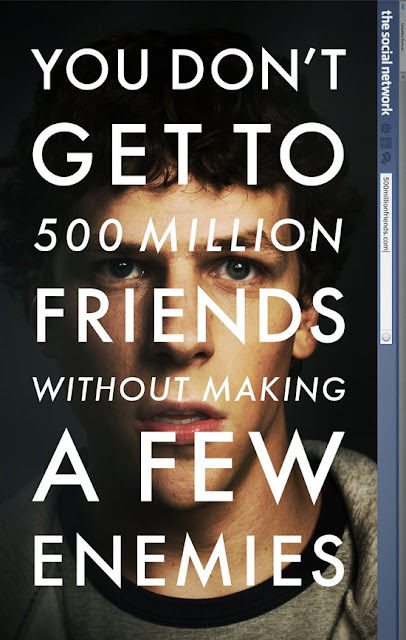
500 Million Friends (or The American Dream)

"Involuntarily I glanced seaward - and distinguished nothing except a single green light, minute and far way, that might have been the end of a dock. When I looked once more for Gatsby he had vanished, and I was alone again in the unquiet darkness." -F. Scott Fitgerald

             The Social Network is easily the critical darling of the year. Everyone talks about the technical genius, the screwball paced dialogue, and the performances, but an examination of the film's relationship to the audience has been largely lacking. I believe that the film's true genius lies in the way it updates "The American Dream" to the modern era. Everyday we see self-made millionaires like Zuckerberg and celebrities with no more claim to fame than being friends with Paris Hilton (or being Paris Hilton for that matter) and we have almost no choice but to think about how it could be us -- suddenly rich for some simple idea or for who we know. That may be "The American Dream" but it isn't "The American Story". That story can be seen everywhere, from works of art like Citizen Kane to real life melodrama like William Randolph Hearst's censorship of that same film. The American Story is broken dreams and the corruption of ideals and no film has better shown it recently than The Social Network.

"I'll see you in my dreams" Essential 5: David Lynch

  "My movies are film-paintings - moving portraits captured on celluloid. I'll layer that with sound to create a unique mood -- like if the Mona Lisa opened her mouth, and there would be a wind, and she'd turn back and smile. It would be strange and beautiful." - David Lynch


David Lynch is the rare artist capable of making the non-rational… digestible… maybe even understandable, and even if we can’t articulate that understanding, we can approximate it. Discussion inevitably turns to the darkness inside us all or the hidden face of seemingly idyllic communities. He often visualizes the fractured psyche, perhaps as a metaphor for society, or individuals, or even himself. Machines are a common motif, often juxtaposed with less ordered, organic imagery like physical deformities, fire, and waterfalls. All of this is true of Lynch, but beside the point. Few film authors are so visual, and none are quite so focused on evoking instead of explaining. Critics love to over-analyze Lynch, and I’m no exception.

For me at least, watching Lynch is like being under a spell. I’m mesmerized by the images, the story, and most of all by what it’s doing to me. Intellectual exercise is generally strenuous, and requires a great deal of conscious thought. With Lynch, though, you feel as if it is your subconscious getting the work-out. After I am done I feel as if I understand myself better or perhaps that I am more comfortable with myself in a way that is impossible to describe. Is intellectualism possible if it eludes your consciousness?
           
I’m going to resist the urge to delve deeper into the state Lynch puts me in. Nothing is more boring than someone else psychoanalyzing themselves. So, here are the essential films of David Lynch. His films taken together create a rich interconnected body of work that is best considered together. But you have to start somewhere and inevitably some make easier entrance points than others. If you are interested in this (very) important filmmaker I recommend starting here:

Monday, July 19, 2010

The Art of Criticism 6: Art and Objectivity

 ...All the same, if you say you dislike "The Godfather" or "Shawshank," I can't say you're wrong. The one thing you can never be wrong about is your own opinion. It's when you start giving your reasons that you lay yourself open. Many years ago there was a critic in Chicago who said "The Valachi Papers" was a better film than "The Godfather." "Phil," I told him, "film criticism is a matter of subjective opinion. Only rarely does it stray into objective fact. When you said 'The Valachi Papers' was better than 'The Godfather,' that was an error of objective fact." -Roger Ebert
All the recent bellyaching about Inception has again led many to criticize those reviewers who gave the film a negative review. This, of course, has opened up a whole can of worms about the value of the film reviewer (often incorrectly equated with a critic), of having dissenting opinions, and what qualifies as a valid opinion. Roger Ebert gives a nice little defense of his profession (above). Yet, I can't help feeling as if he's dancing around the solutions. He's certainly right when he states, "film criticism is a matter of subjective opinion." The problem though is when he tries to bring objectivity into the equation. Briefly, objectivity is "mind-independent" or free from any judgments made by an entity. This excludes Science, Religion, Literature, Film, etc, etc. The only things it doesn't necessarily exclude are Mathematics and Philosophy, the only fields where actual "discoveries" are made (not "inventions"). Basically, I point this out in reference to Ebert's quote from above, "only rarely does it stray into objective fact." What exactly is an "objective fact" and how is it different from a fact (and what does this have to do with anything?)? I'll tell you:

Sunday, July 18, 2010

"Man... is above all the plaything of his memory. "

Inception is easily the most divisive film of the year thus far (and lets face it, that's because its the only film released thus far that has both artistic intentions and box-office returns). I have a strong aversion to writing reviews, particularly in this sort of maelstrom, but I feel that I have to extract some thoughts (Harry Potter style!) and put them in my own personal pensieve. Before I get into the two specific things about the film I want to talk about, I suppose I should give my general thoughts on the film so you at least know where I'm coming from. Basically, I enjoyed it... which can be interpreted as I think it was cool, but not half as smart as it pretended to be.